Skip to content

Winter Squash Coconut Muffins

Winter Squash and Coconut Muffins

One of my favorite things to do with winter vegetables like beets and winter squash–both of which take a while to roast–is to roast big panfuls to have on hand for any number of savory or sweet uses. Since the roasting is basically unattended you can do it while you’re in the kitchen making something else for dinner or whenever you happen to be home for a bit or your oven is already on.  It then seems like such a coup to have those sweet, tender chunks of goodness in your fridge whenever you want them. I think of this as another element in my prepared pantry. A term I use to describe all those things (veggie bouillon, cooked, frozen beans, etc.) that enable you to make fast food with real, wonderful ingredients. I think I’ll devote a whole post to this concept one of these days. And as a matter of fact, some of my upcoming classes–Pantry Stocking & Quick Meals and Kitchen Confidence: Techniques &  Tools, Variations & Combinations–focus on just such things.

Sometimes I don’t even manage to make them squash or beets into anything but just snack on them or serve them as a side with good olive oil and salt and a drizzle of sherry vinegar for the beets. But often they go into salads or a risotto or soup or curry. The other day I had a bunch of roasted squash in the fridge as well as a partial can of coconut milk which I knew wouldn’t last much longer. So out of these two items these muffins were born.

The coarse sugar and toasted coconut make for a nice, crunchy topping. Don't skip this part--it really adds and you use more of the coconut in the batter it anyway.

The bake-with-what-you-have strategy does not always work but this time it did and I will open a new can of coconut milk and roast squash for just this purpose in the future. I added some chopped golden raisins (whole my son picks them out but chopped he doesn’t mind them) for sweetness, a bunch of fresh, grated ginger and some toasted shredded coconut. Next time I’m going to try adding some lime or lemon zest just for fun but there already is plenty going on in these. And in the bake-with-what-you-have vein, I’m sure these would be good with nuts instead of raisins or other dried fruit or different sweeteners so play around and let me know how it goes.

These muffins keep quite well since the squash keeps them moist.

Winter Squash Coconut Muffins

These muffins are not very sweet so up the sweetener a bit if you’d like. And the sweetness will also depend on the kind of squash you use. I used buttercup and would recommend it, kabocha, hubbard or butternut. You want a dense, dry-ish fleshed, sweet squash. But then again, use whatever you have and see how it goes!

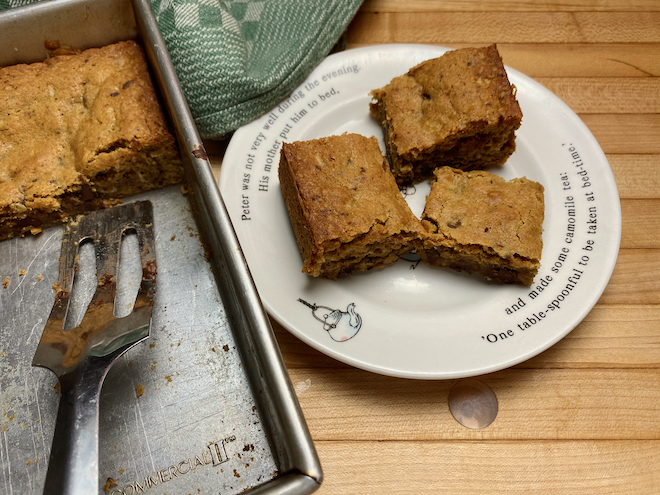
About 16 – 20 muffins (I made 12 regular sized-ones and 8 smaller ones — see photo)

1 cup all-purpose flour
1 cup whole wheat pastry flour (or spelt flour, etc. )
3/4 cup coconut sugar (or brown or regular granulated sugar)
2 tsp baking powder
1 tsp baking soda
¾  tsp salt kosher salt
1/2 teaspoon ground cinnamon
1 tablespoon freshly grated ginger
Generous 2 cups roasted winter squash
1/2 cup golden raisins (chopped if you have raisin dislikers in your circle)
1/2 cup plus 3 tablespoons unsweetened, shredded coconut lightly toasted, divided (I did this while I was preheating the oven)
1 1/2 cups coconut milk (preferably full fat)
2 eggs
1 tsp vanilla

Topping:
2 tablespoons coarse sugar such as demerara or turbinado
3 tablespoons toasted, shredded coconut (from quantity listed above)

Preheat oven to 375. While it’s heating spread the shredded, unsweetened coconut on a sheet pan and toast until just beginning to turn golden. This can take anywhere from 5- 10 minutes. Check often and be careful not to burn.

Put the squash, eggs, ginger, coconut milk and vanilla in a blender or food processor and process until smooth. Alternatively you can mash the squash with a fork (it should be nice and soft and easy to do) and then whisk all the wet ingredients together by hand.

Whisk the flours, sugar, baking soda, baking powder, cinnamon, and salt together in a large bowl. Add the squash coconut milk mixture, the raisins and toasted coconut (be sure to reserve 3 tablespoons for the topping) and stir until just combined. Don’t over mix.

Portion the batter into muffin tins, filling each one about 3/4 full. Sprinkle each unbaked muffin with the coarse sugar and toasted coconut, lightly pressing down on the topping so it sticks well.

Bake for about 15 – 18 minutes or until a tester comes out clean.

Rice Custard

One of the first things I remember my husband cooking was this rice custard. We have been together 19 years today and I remember him talking to his mom over the phone asking her to track down this recipe that he had made as a kid. The phone conversation resulted in a somewhat terse handwritten version on a scrap of paper that he occasionally unearthed from my overflowing recipe binder over the years. Many years later his mother gave him the old Fannie Farmer Cookbook (1959) where this recipe originated.

Rice Custard from the 1959 The Fannie Farmer Cookbook made by my husband Brian.

This last weekend Brian made the rice custard again, on a lovely lazy Saturday (the first Saturday in a month that I hadn’t taught a class) and we ate rice custard at 4:30pm with the sun shining in the window. Ellis exclaimed gleefully mid-way through his bowl, “we’re having dessert right before dinner!” I spooned the very last of my boozy fruit (mostly cherries preserved in rum that had been “marinating” for 7 months now) over the custard and found the custard to be the perfect foil for it.

So there we were the three of us, eating warm, luscious rice custard on a late afternoon in February almost 20 years since Brian and I first met. As old as I sometimes feel these days, life also just seems to be getting better and better. And food made with love . . . don’t need much more than that.

Rice Custard
 –adapted from The Fannie Farmer Cookbook (1959)

Heat in a double boiler (or any heat proof bowl over a pan of gently boiling water)
2 cups milk
2 generous cups cooked rice (we use white Jasmine but short grain brown or white could work too) from one cup uncooked rice.

Beat until smooth in a separate bowl
2 egg yolks
scant 1/2 cup sugar
1/4 teaspoon salt

Add the hot milk and rice slowly, whisking constantly, to the egg yolk and sugar mixture. Pour back into the double boiler and cook until thick (about 10 minutes would be my guess).

Remove the bowl from the heat and stir in the zest of half a lemon and 1 teaspoon of lemon juice and/or 1 teaspoon of vanilla extract. Gently fold in the two stiffly beaten egg whites (leftover from your two egg yolks earlier). It’s best warm, right after it’s made.

Enjoy!

Happy Valentine's Day

Frittata

It’s like a pizza but eggy! That’s how my five-year-old (as of yesterday five-year-old!) said to his teacher this morning when asked what his favorite food at his birthday party had been. I beg to differ on the likeness to pizza but it is one of my favorite dishes. I teach it regularly in vastly different incarnations but have never written about it here.

Frittata with kale, chili flakes and nutmeg

It’s a bit like pizza in that you can adapt it endlessly and it hails from the same country but that’s about it. There’s no yeast dough to make and let rise and there’s no floury mess to clean up. Don’t get me wrong, I love pizza but don’t find myself making it when I have a hungry crowd to feed and only 20 minutes in which to prepare something.

A frittata can be as simple as the one in one of my favorite scenes in one of my favorite movies — Big Night — as in just egg and salt. The eggs are lightly beaten, seasoned and then cooked in a skillet until firm. When I experienced them being in made in Italy they were usually flipped part way through, usually with the assistance of a little crust of bread that served as the heat absorbing extension of your hand when managing the flipping maneuver.  I’ve long since adopted the finishing-in-the-broiler method instead of flipping but if you’re lacking excitement in your cooking routines by all means, flip away! As a matter of fact my broiler quit working in class once a long time ago and I found myself needing to flip a 12-egg frittata in a huge cast iron skillet so if you’re lacking a broiler, you’ll get your practice in any case.

This weekend I made two frittate for my son’s birthday party: one with finely chopped, kale, onion, chili flakes and a bit of nutmeg and one with diced potatoes, sausage and fresh oregano. They really are the easiest, most portable and nourishing item to make for a party. They are delicious at room temperature and you don’t need a fork or even a plate. With the addition of meat and potatoes they are even heartier and they are the perfect foil for bits and pieces of vegetables that may be in the bottom of your crisper. Some of my favorites include lots of herbs either alone or in combination–parsley, basil, chives, thyme, tarragon, etc. And this time of year the hearty, leafy greens or leeks (with thyme and goat cheese) are my standby’s.

The birthday party frittate from this weekend: kale, chili flake and nutmeg, and sausage and potato.

Leftover wedges of a frittata make a wonderful sandwich filling paired with a little arugula, a few slices of onion, and a drizzle of olive oil. If you have leftover spaghetti or other pasta (sauced or unsauced) you can chop it up a bit and saute it briefly in a skillet and pour the egg over the pasta for a perfect second incarnation. So you get the point, if you have little time and a few eggs on hand, dinner is just a matter of minutes away.

Frittata with Greens

This is one of my quickest, go-to dinners for a busy day. The options are literally infinite as to what to include. In this version you can use a lot of greens and just have the egg hold it all together or you can use less greenery and have it be more eggy—it’s really up to your taste. This is wonderful the next day in sandwiches or as a snack. It’s just as good at room temperature as it is hot.

1 bunch greens (chard, kale, collards, etc.)
1 -2 tablespoons olive oil
6-8 eggs (or whatever you have on hand or want to use)
Dash of freshly grated nutmeg (optional)
1/8 – 1/4 teaspoon chili flakes (or to taste)
1-2 ounces grated hard cheese or your choice or feta or goat cheese (optional)
Salt, pepper

Heat the oil in a heavy skillet or well-seasoned cast iron pan. Rinse the greens and remove any tough stems. If you’re using chard, remove the stem and chop finely and sauté for a few minutes before you add the greens. Cut the greens into thin ribbons (easier to handle that way and cook down more quickly). Add greens and a few pinches of salt to the pan and sauté over med-high heat until they’re tender. You may need to add a splash of water to keep them from burning and sticking. And the length of time will depend on the kind and variety of green. Most cook in about 10 minutes or less. Set your oven to broil.

Lightly whisk the eggs until they’re just broken up—no need to get them frothy or really well mixed. Add a few generous pinches of salt and several grinds of pepper, the chili flakes, and the nutmeg (if using). Pour eggs over the greens and tilt the pan to evenly distribute the eggs. Sprinkle the cheese over the top of the eggs, if using. Cover and cook on medium heat for a few minutes. When the eggs begin to set and the sides are getting firm take the pan off the heat and set under the broiler until the eggs are cooked and slightly puffed and golden. Let sit for a few minutes before cutting and serving. It will come out of the pan much more easily that way. Serve with a slice of bread and salad. Variations: Add bacon, sausage, leftover pasta, most any other veggie (sautéed leeks or onions, broccoli, potatoes, mushrooms, peppers, asparagus, spinach, diced carrot, zucchini . . .)

Happy Cooking and Eating!

P.S. I’ve posted some new classes, including another Eat Better Series later in the spring, a class on everyday savory and sweet baking, one on techniques and tricks and more!

Good, Quick, Chocolate Cookie

A tin of these fudgy chocolate cookies is a mighty nice thing to have around.

Lest you think it’s all root veggies and  greens around here, I present to you the quickest and one of the most satisfying cookies I make. Actually last Saturday was the first time ever that I taught a class and sent people home without a treat. Even for the students who had never been to a class and wouldn’t have known any better I had to do a spiel about how this class was shorter, focused on winter greens and how I managed to squeeze five dishes into our 90 minute class which is why they weren’t getting dessert. They were gracious and I think will return, however, I do love to bake and even if class time doesn’t permit the making or even eating of something sweet, there are always those little waxed paper bags concealing something for the road on your way out the door.

This cookie is in that rotation. And I, in my cook-with-what-you-have fashion, vary them each time. Sometimes I use whole-wheat pastry flour, sometimes spelt or sometimes just all-purpose. Today it’s golden raisins but sometimes it’s dried cherries or apricots. I even vary the amounts of cocoa a bit. And today I found a few tablespoons of orange marmalade in the fridge as I was preparing to make these and ended up mixing that in. I’ve always loved the combination of orange and chocolate and I’m definitely going to repeat that variation.

So if you have 20 minutes (that includes the baking time!) and some cocoa on hand and a few other pantry basics you can have your chocolate/cookie fix in no time. And you mix the dough in a sauce pan so clean up is fairly minimal too.

You start by melting the butter and then adding the cocoa and sugars and then all the remainder of the ingredients right in the saucepan.

Fudgy Chocolate Cookies
–adapted from pastry chef, writer, food stylist and friend Ellen Jackson

You can mix these incredibly easy, fudgy cookies right in the saucepan. I add golden raisins or chopped dried apricots, cranberries or dried cherries or chopped crystalized ginger to these depending on what I have on hand. In today’s batch I added a couple of tablespoons of orange marmalade (a definite winner), in addition to golden raisins. You can also omit the dried fruit or add nuts and dried fruit.

1 cup all-purpose flour, spelt or whole wheat pastry flour
1/4 teaspoon baking soda
1/8 teaspoon salt
5 tablespoons butter
6-7 tablespoons unsweetened cocoa
1/2 cup granulated sugar or coconut sugar
1/3 cup packed brown sugar or coconut sugar
generous 1/3 cup plain whole-milk yogurt
1 teaspoon vanilla extract
½ cups dried fruit (see headnote)

Preheat oven to 350°. Combine flour, soda, and salt and set aside. Melt butter in a large saucepan over medium heat. Remove from heat; stir in cocoa powder and sugars. Add yogurt and vanilla, stirring to combine. Add flour mixture, stirring until moist. Drop by level tablespoons 1 inch apart onto baking sheets. Bake at 350° for 8 to 10 minutes or until almost set. Don’t over bake and err on the side of underdone, if you like moist, chewy cookies that is. They will firm up as they cool. Cool on pans 2 to 3 minutes or until firm. Remove cookies from pans; cool on wire racks.

Kissin’ Wears Out, Cookin’ Don’t!

I heard this one for the first time yesterday at a talk I gave at the Alameda Tuesday Club, a local Portland philanthropic and social group with a fascinating 100-year history. Judy, the woman who shared this said that it is an Amish saying and I knew I’d find use for it right away.

And I hope there’s some truth to it because I think I’m on the verge of wearing you all out with root veggies. Next week you’re going to get a break from them for sure but this week I am eager to answer some of the questions that surfaced from last week’s post. I received inquiries about what to do with parsnips and cabbage so here we go.

On the cabbage front this gratin and this soup should serve you well. I was also asked about how to make cabbage a little more kid-friendly and in my experience the below recipe for Japanese Cabbage Pancakes (Okonomiyaki) is a great way. Please report on how they go over.

Sliced parsnips, celery root and rutabaga.

Now to Parsnips, which are inherently very sweet and if fresh, very tender. Their core can get a bit woody and fibrous if they have been in storage for a long time but before you cut out the core (which is kind of a pain to do), taste a thin slice raw and you’ll be able to gauge whether or not you can keep it. Chances are you can especially if you’ve gotten them from a farmers market or CSA box.

Parsnips are wonderful additions to this veggie hash or these latkes. However, for a dish where they truly shine, try this light “cake” in which they are paired with celery root. Often gratins are heavy on the cheese and/or milk.  However, in this version, some simple broth or stock  (or veggie bouillon) provides the moisture and thyme, salt and pepper are the only seasonings and the result is light yet sweet and rich from the veggies themselves.

Parsnip and Celery Root "Cake"

It would be awfully hard to wear me out on root veggies and winter produce in general so I definitely stand by the Amish saying (at least the latter half!).

Lastly, I have a couple more spots in this Saturday’s Greens Class (a short and inexpensive class) and  have posted  a handful of new ones!

Happy Cooking and Eating!

Parsnip and Celery Root Cake
–adapted from Tender by Nigel Slater

You can make this as written with parsnips and celery root or substitute rutabagas or turnips for the celery root. I’m sure potatoes and sweet potatoes would be comfortable in the mix too so feel free to use it as your use-up-random-veggies dish if you need to. I made the dish pictured above with parsnips, celery root and rutabaga and it was delightful.

As I note above, parsnips can have woody and fibrous cores but if they are quite fresh they probably don’t and you don’t need to cut out the core. Taste a thin slice raw and see how it seems. I’ve found that parsnips I buy at the farmers’ market are quite tender all the way through, even the really big ones.

You want to slice your veggies very thin. A sharp knife works great if you’re comfortable and a bit practiced and the food processor is a good alternative too.

1 large onion, thinly sliced
1 large or 3 small (or 2 medium!:) parsnips, scrubbed and thinly sliced.
1/2 a medium celery root, peeled and thinly sliced
4 tablespoons butter
1 teaspoon fresh or dried thyme, chopped up a bit
6 tablespoons vegetable broth or stock (I use veggie bouillon)
Salt and freshly ground pepper

Preheat oven to 375 Degrees F.
Toss the sliced onion and veggies in a large bowl with they thyme, at least a teaspoon of sea or kosher salt and plenty of pepper. You need to be generous with the salt.

Put the butter in a baking dish and place it in the oven while it’s preheating. When the butter is melted add the veggie mixture and combine well and pack the veggies down as evenly as possible. Pour the stock or bouillon over the mixture. Place a piece of wax paper or aluminum foil over the veggies and press down firmly. Bake for an hour and then remove the foil and turn your oven up to 425 (or to broil if you’re in a hurry) and cook for another five minutes or so until the top is nicely browned and the veggies are very tender.

Japanese Cabbage Pancakes (Okonomiyaki)
–adapted from Food52.com 

These pancakes are fantastic. They make a light supper with a salad on the side. Don’t be put off even if you don’t love cabbage. They are quick, cheap, and I have yet to encounter any resistance to these, adults and kids alike. Traditionally they include shrimp though I always make them without and love them that way but by all means add 1/2 cup of chopped shrimp if you like.

Makes about 12-18 pancakes (depending on how big you make them).

Sauce:
Scant ½ cup mayo
Scant 2 tablespoons soy sauce
1 tablespoon Sriracha (or other hot chili sauce)

Pancakes:
3-4 large eggs
1 teaspoon soy sauce
1 teaspoon sesame oil
1 – 11/2 teaspoon sea salt
1/3 cup all-purpose flour
4 cups cabbage, finely sliced
1 bunch scallions, trimmed and chopped (or some thinly sliced red or yellow onion if that’s what you have)
Olive, coconut or peanut oil for pan-frying
1-2 tablespoon toasted sesame seeds

Whisk the first set of ingredients together for your sauce. Set aside while you make the pancakes.

In a large mixing bowl, whisk eggs with the soy sauce, sesame oil, and salt. Gradually add the flour until incorporated. Fold in cabbage, scallions, and shrimp. Warm a tablespoon or so of oil in a skillet over medium-high heat until glistening. Spoon the batter into the skillet in whatever size you like. I make them about 4-5 inches in diameter. Cook on each side for about 3 minutes or until golden brown. Keep pancakes covered in a warm oven as you make the rest. Scatter sesame seeds on top of pancakes and serve with dipping sauce.


Winter Recipe Challenge

Garlic, yellow onions, russet or purple potatoes, Napa cabbage, collards, carrots, parsnips, beets, and rutabagas. . . that is the text I received last week from one of the farmer’s I work with. This is the list of produce members of the farm’s CSA received this week.

I get this list a few days before the share pick up and go to work collecting, testing, and adapting recipes to accompany the produce. It is particularly fun doing this work in the winter as we are blessed to live in a place where one truly can eat locally year-round. And since the bounty is actually so diverse here in the winter I have eaten well for many winters (buying at the farmers’ markets here) without eating many, if any, rutabagas or turnips. With this new gig, however, that’s changed and I am forever grateful.


So the winter recipe challenge is as follows: If you have been or would like to be buying local produce this winter and are curious how best to prepare something new to you.. .. or if you need a new idea for an old standby, post a comment below and I’ll do my best to respond next week with ideas or recipes. Or if you have favorite tricks and recipes, please share those as well!

The choices are certainly fewer this time of year than at the height of the growing season, however, the possibilities are not. And by having one’s grocery shopping choices eliminated (or narrowed) by the farmer (or the market vendor) we can spend our creative energy making the most of these delicious veggies that have stored up a summer’s worth of sun for us to enjoy this time of year.

And if you are curious about CSA (and happen to live in the Portland area) I will be teaching a class with Shari Raider of Sauvie Island Organics on February 4th where we’ll not only cook with local veggies but have Shari on hand to answer questions about our winter (or any season) veggies, the connection between farmer and eater and all that goes into growing food. Join us for what’s sure to be an interesting few hours of good cooking and conversation. I will be working with Sauvie Island Organics this year to create recipe packets for their CSA as well and if you sign up for their share this month you get a nice discount on any/all Cook With What You Have classes this year.

On another local note, Slow Food Portland is hosting a panel discussion on small-scale meat processing in our area. The event is next Thursday, January 26th. Visit Slow Food Portland for details.

Don’t forget to submit your comments with winter veggie questions or favorite preparations of yours, and check back next week for lots of new ideas on how to prepare them!

Happy Winter Cooking and Eating!

Genius Recipe


That’s a risky title. When I worked at a restaurant many years ago the chef, wisely, noted that you should never call anything the “best this” or “world-famous that”. . . it’s annoying, it’s highly subjective, so on and so forth. I think this falls into a slightly different category. The folks at Food52 ask folks to submit genius recipes and I believe they define them as just plain smart, unusual, surprisingly delicious, and/or unexpected in their simplicity and success. I’ve been meaning to submit this recipe to them but in the meantime, here it is. And it has an irreverent title to boot!

It’s toasted bread, rubbed with garlic, slathered with pesto and doused with brothy black beans. That’s it and it’s really, really good. Make it and tell me when you do and what you think.

Zuppa Bastarda (“Bastard Soup”)
–inspired by Carol Boutard (of Ayers Creek Farm) who got the recipe from Nostrana which got the recipe from Anne Bianchi.

Bastard soup is so named because it uses black beans, which are called fascistini in honor of what Elda Cecchi calls “that black shirted bastard who brought Italy to the brink of destruction during WWII.”

It’s very simple to make. And if you have previously cooked black beans with their broth on hand by all means just use those. The garlic and pesto on the toasted bread add lots of flavor so don’t be put off by its simplicity.

1 ¼ cups dried black beans, soaked (or 3 cups of cooked black beans in their cooking liquid, see headnote)
6 cloves garlic, peeled
1/2 medium onion, peeled and cut in half
2 tsp dried crumbled dried sage or chopped, fresh sage
6 3/4-inch thick slices good bread, toasted
Salt to taste
Freshly ground black pepper
6 tablespoons basil pesto
2 tablespoons extra virgin olive oil

Drain the beans and place in a soup pot along with 3 cloves of the garlic, the onion, sage, 1 1/2 teaspoons kosher salt and enough water to cover by 2 inches. Heat to boiling over medium heat. Reduce the heat to low, cover and cook for 25 – 45 minutes or until beans are tender. Cut the remaining garlic cloves in half. Using half a clove for each 2 slices of bread, rub the bread with the cut sides of the garlic until the bread is perfumed with the odor, spread about 1 tablespoon of pesto on each slice. Divided the slices among 6 bowls and pour the bean soup into the bowls over the bread. Drizzle with olive oil. Serve hot.

Happy Cooking and Eating!

P.S. I’ve posted a bunch of new classes, shorter, cheaper and with new subject matter, including one for youth/kids and pantry stocking/quick meals one.

I used Black Basque beans (grown by Ayers Creek Farm in Gaston, Oregon) this time around and they have a much lighter hue when cooked. Usually I use Black Turtle beans which are much darker. It works well with both or probably any other kind of black bean you have. Getting the best, freshest beans you can find is always good though.


Ode to the Box Grater and Unconventional Latkes

I use my box grater most days. I’ve been grating carrots and rutabagas and making “latkes” with them. I’ve been grating beets and turnips and carrots and making a salad with toasted sesame seeds and a lemony dressing. I’ve been making celery root remoulade the classic French salad of grated raw celery root with a creamy mustardy dressing (though I use Greek yogurt instead of mayonnaise). I’ve been making delicata squash pancakes and grated sweet potato and regular potato and parsnip pancakes.

Turnips, sweet potatoes, celery root and carrots, the latter pulled from my garden this morning. . . These were the roots I happened to have around today but so many others--parsnips, rutabagas, beets, potatoes, winter squash--lend themselves to grating.

I love my food processor and its coarse grating blade too but I’ve reached for the good old box grater more often lately. It’s easy to clean, lives in a central drawer and requires no moving, assembling, or non-human power.

And tools aside, these grated concoctions are winners. There’s no better way to enjoy (or get unfamiliar veggies into skeptical tummies small and large) than grating them, mixing them with a light batter and pan-frying them into crisp, spidery pancakes.  Nor is there a better way to put a wintry salad on the table since the grating softens the veggies and enables them to soak up zippy dressings with lots of herbs and acidity.

In addition to writing about box graters and root veggies I had planned to write some sort of New Year’s greeting, but this morning I read this post and have been thinking about it ever since. I hope you enjoy it as much as I did. And I’ll just say what a pleasure it is to cook with the beautiful produce our fabulous farmers grow and that I hope to increase access and knowledge and comfort with it, both with new and familiar folks in 2012.

And finally, there are lots of new classes posted, including another round of the Eat Better Series, which is a great way to start the new year. So if you received a gift certificate for a class or have been wanting to take one or would like a “tune up” I’d love to see you here.

Happy New Year!

I shouldn't really call these latkes since they have cream or milk in the batter but they are worth trying with most any root veggie you have on hand.

Rutabaga and Carrot “Latkes”

I referenced this recipe last week and received quite a few questions asking for more details and a real recipe so here you go.

This is more of an idea/technique than a recipe and it’s not an authentic latke. Be that as it may it’s a great, great way to enjoy winter (especially root) veggies. You can also include or substitute turnips, celery root, sweet potatoes or potatoes. The quantities listed are approximations and can be adjusted based on what you have on hand, your taste, etc. For the below recipe you want about six cups of packed, grated veggie.

1 smallish or half a larger rutabaga, peeled and grated on the large holes of a box grater or shredded with a food processor
3-4 medium carrots, scrubbed and grated (same as rutabaga)
½ a medium onion, finely diced
2 tablespoons chopped fresh parsley (or oregano, mint or chives or about a teaspoon of chopped sage or thyme, fresh or dried) optional
2 eggs
¼ cup flour
½ – 2/3 cup of cream or whole milk
Salt (at least 1 teaspoon kosher)
Freshly ground pepper
A few tablespoons of oil for pan-frying
Greek yogurt or sour cream for serving

Let the grated veggies rest, sprinkled with a little salt, in a large bowl while you prepare the batter. In a smallish bowl whisk the eggs with the flour and cream, salt and pepper. Squeeze out any excess liquid from the veggies with your hands, a big handful at a time. Return to the bowl; add the onion and herbs and finally the batter. Mix well. Taste for seasoning before you start frying. Under salted latkes are no fun.

Heat a large skillet over medium-high heat with a tablespoon or so of olive oil. Scoop large spoonfuls of the mixture into the hot pan. Flatten each one a bit with a spatula. Leave them alone for a few minutes until the sides start getting crispy and golden. Flip carefully and continue cooking until both sides are nicely browned. Eat hot topped with Greek yogurt or sour cream.


Winter Comfort (Caldo Verde)

Curly Savoy Cabbage

Cabbage, turnips, rutabagas, celery root, carrots, beets, and kale are my dear friends this time of year.  Yesterday I was writing my E-newsletter and I started with: “if you need to use up half a rutabaga and a few carrots. . . .” and then stopped and changed that to: “this recipe is a great way to enjoy rutabagas, carrots, . . .”.  It got me thinking about the semantic treatment of the less-than-sexy veggies or maybe any bits and pieces that remain in the crisper long after they’ve been purchased.

My four-year-old and I devoured the rutabaga and carrot latkes I was writing about and he requested that I make them for lunch everyday now. They were just plain delicious. So I am consciously changing my recipe writing tone to promote these winter workhorses that are packed with nutrients, endlessly adaptable and combinable, and in season in many parts of the country right now.

Today’s post features one of those winter veggies that keeps in the crisper (and stays crisp) for weeks: cabbage. Cabbage and potatoes showed up here just a few weeks ago but today’s recipe for the Portuguese Caldo Verde is completely different, quick and so satisfying.

Cabbage, potatoes, and chorizo

An early Christmas present to myself in the form of Tender, Nigel Slater’s completely absorbing book about veggies, inspired the revival of this dish in our household. . .as well as the ever-present half-head of cabbage in the fridge, and my job writing recipes for CSA Farm members.

Caldo Verde--Just as good or better the next day though a little less photogenic.

Caldo Verde (Cabbage and Potato Soup with Chorizo)
–adapted very slightly from Tender, by Nigel Slater 

Savoy cabbage is very good in this but regular ol’ green cabbage or any kind of kale works just as well. One chorizo is really plenty to flavor this soup well but if you’ve got meat lovers at the table feel free to toss in another. If you’d like to make this without the meat, I would add a teaspoon or two of smoked Spanish paprika (Pimenton) and another clove or two of garlic at the beginning.

Serves 4

Olive oil
1 medium onion, diced
2 cloves garlic, thinly sliced
3 -4 medium waxy potatoes such as Yukon Gold, scrubbed and cut into medium dice
4-5 cups water or broth
2 bay leaves
1 chorizo sausage (about 4 oz), cut into thin rounds
4 cups Savoy cabbage (or other, see headnote), cut into thin strips
Salt and pepper
Good olive oil for drizzling

Saute the onion and garlic over medium-low heat in a large pot in a bit of olive oil until soft, about 10 minutes. Add the potatoes and cook for a few more minutes before adding the water (or broth), bay leaves and salt and pepper. Bring to a boil, then turn down and simmer for about 20 minutes or until the potatoes are quite soft. Meanwhile fry the slices of chorizo in a small pan until they are crisp and the fat has been rendered.

Mash the potatoes in the pot with a fork or potato masher until partially broken down. You want the potatoes to thicken the soup but also leave plenty of lumps. Add the cabbage and cook for a few minutes until tender. Add the chorizo, adjust for salt and serve the soup drizzled with good olive oil and another grind of pepper.

Happy Cooking and Eating!

Apple Cider Syrup

Apple cider cooked down to a syrup. Spectacular in salad dressings, cocktails, etc.

I have a few aces in my cooking repertoire, not that many, but a few. And this one is probably at the top of the list. Like most things I cook and teach it’s pretty straightforward, laughably simple actually. It came about a few years ago when I had lots of apple cider left over from my family’s cider pressing party. So I decided to reduce about a gallon of the cider until it just got syrupy which took my gallon down to about a pint. (If you reduce a bit too far, add some cream and a little salt for the most divine apple cider caramel sauce!)

I started using a teaspoon or two in salad dressings and I was hooked. The stronger winter greens this time of year are perfectly complemented by this “mystery” ingredient in the dressing. Countless times people have asked me what was in my salad dressing and a friend now can’t make big enough salads since her 8-year-old eats practically the whole bowl. I have to admit this has not worked with  my 4-year-old  . . ..

This syrup also inspired the Party Class I co-taught with cocktail wizard Scott Taylor this last weekend. He encountered the syrup in a Beans Class  (that by the way I’m teaching again with new recipes January 7th) earlier this fall and immediately went home and started mixing drinks with it. It is a winner mixed with bourbon, ginger syrup, bitters and lemon!

Cider syrup over Greek yogurt.

Beyond salads and cocktails the syrup is wonderful over ice cream or Greek yogurt, drizzled onto soups or braises or roasted vegetables or fruits, on pancakes or waffles. . .. It’s sweet and tart and complex and contributes almost anywhere. So go buy a couple of gallons of apple cider, reduce it and give your friends who like to cook and drink a little jar or it as a gift. Or just make a bunch and freeze some. It also keeps well in the fridge for several months.

And speaking of gifts, you might also give the gift of a cooking class (to yourself or others) this season– a gift that doesn’t clutter anyone’s home yet makes a daily difference for the tummy!

Apple Cider Syrup

1 gallon apple cider (not apple juice)

In a large pot or saucepan bring the cider to a boil. Let boil, uncovered until gallon has reduced to approximately two cups of syrup and consistency is thick enough to coat the back of a spoon. This can take anywhere from 40 to 90  minutes depending on the size of your pan, the strength of your stove, etc. Refrigerate or freeze when cool.

Follow

Get every new post delivered to your Inbox.

Join 301 other followers